Full transcript of the conversation, published verbatim. Speaker labels come from the recording itself, not from an automated guess.
Carl Holden:0:00
Welcome to What's Made in the USA, the podcast that celebrates the people, companies, and ideas behind American manufacturing. I'm your host, Carl Holden, and on each episode, we meet the entrepreneurs, engineers, and skilled professionals who are building real products right here in the United States. Today I'm pleased to have Paul McMinn of Stockton Products, headquartered in Las Vegas, Nevada. Let's get started. Welcome, Paul.
Paul McMinn:0:26
Thanks, Carl, for having me.
Carl Holden:0:28
I'm glad to have you here. Well, let's go ahead and jump right in, Paul. If you could give us a top-level overview of what you make at Stockton Products.
Paul McMinn:0:37
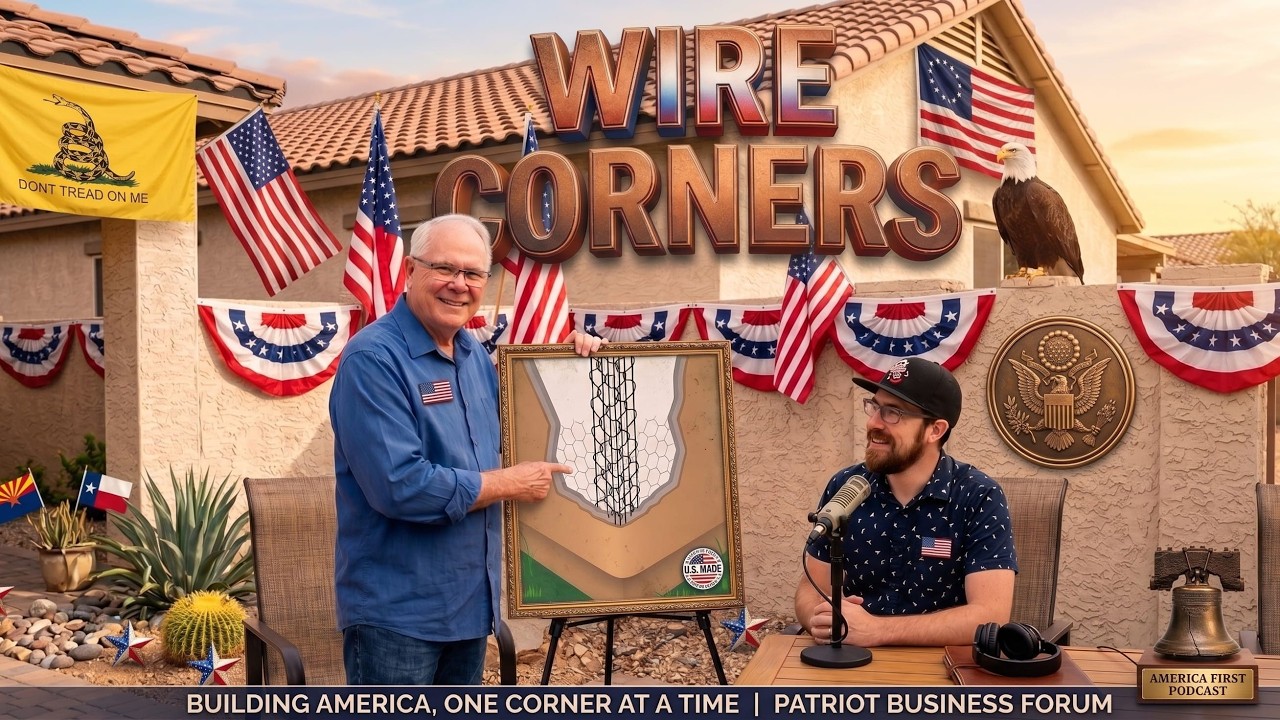
Sure. Stockton's been in business since 1949. We essentially have two different products we make. We've pioneered a product called Cornerade. had a patent on that in the early 60s. it's welded wire for stucco. If you can think of a chain length fence, that's about nine gauge. this product is about 17 gauge, so it's much thinner. but interestingly enough, there are no US or domestic suppliers of this product. The raw material has to come from overseas because of of technical issues. So we weld that together and it goes on the corner of buildings around windows and doors before the stucco is applied to the lat. So our product is really kind of the Kleenex of its its welded wire corner. So that's our primary product.
The other half of our business is metal fabrication. we use laser punch brake press, mostly in the construction markets, multi-family, single family homes, hospitals, schools, whatever. and that's you know laser we take steel. If you think of a coil of steel, it looks like a roll of toilet paper except it's much larger. You take that and you slit that to either a coil or a sheet and then you put holes in it. you bend it to a specification, to a customer specification, and and it goes on the building or it can go into different types of products. Anywhere metal is concerned, that's kind of what we do start to finish.
Carl Holden:2:28
Okay, so it sounds like you use the metal fabrication to do a set of products, but you also are a fabricator if someone comes off the street and says, I need this, you know, set of parts made or longer. Like, are you then making other products for people? Or is this kind of metal products for specific projects? Like I guess what I'm asking is are you the designer sometimes and manufacturer of other product lines that aren't technically your IP.
Paul McMinn:2:59
Yes, that's a that's a good differentiation, Carl. It's we do probably ten percent of our business is probably custom fabrication. The customer will either give us a drawing or design. it could be on a napkin and we use products like SolidWorks and CAD design to turn that into a three dimensional drawing for our CNC machines, it it turns the drawing into a a technical drawing that we can then send to the machine and the machine understands what the drawing is and whether it's capable of making that product or not. So it depends on what the customers look for, I would say.
A lot of our business recently is coming from a data center construction. metal components supporting cooling. It just depends on what it is. If it's metal and it has to be formed, bent, or so forth, that's that's a a growing part of our business.
Carl Holden:4:01
You said that's about ten percent. Is the other ninety percent this specific these sp specific product lines that you have?
Paul McMinn:4:09
it is, Carl. Those are the bulk of our business is manufacturing product. Originally it was just for stucco construction, and in the US that's primarily as an exterior cladding. That's typically Texas and West in terms of a market. it's not but there's also could be brick or stone exteriors if there's a transition. one of our products is a soffit vent. that's underneath that allows the air to flow through the attic space of a house. a lot of that we either put holes in it, we bend it to shape, or it's done on a roll former. So we punch holes in it and it goes through a series of rollers to create a shape. And So that's kind of how we do it, but primarily the business vertical we're in is construction materials. So it's all housing and h however a housing market is going, that's affecting our business. we're trying to diversify into other markets so we're not subject to the ups and downs of the construction industry and certainly interest rates and money that finances these projects have a large factor in that.
Carl Holden:5:26
You mentioned welded wire and welded wire mesh. I do you do you supply the other types of welded wire? Is that a specialty of yours or is it just the stucco?
Paul McMinn:5:38
It's it's primarily stucco applications. if you've ever seen it being done, there's two ways to do that. Either some people just call it chicken wire when they when they're building a house, they'll put the sheeting over the the wood, the framing, they'll have the tar paper on there, and then they'll attach it's met it can be metal lath, which is looks like diamond, a piece of metal that has diamond shapes in it. it could be a woven.
Wire product. That's what's typically looks like chicken wire if you're familiar with that. But it all acts as a substrate to support the stucco, and it's usually furred or about a quarter of an inch away from the paper, so it has an ability to embed. So once that's on the building, our product goes over that on the edge of the building, doors, and windows, as we discussed before. And our product is that lath that goes on the building that can be. either be woven or welded, but it's typically either 17 gauge or 20 gauge wire. And again that's hard to find. There's no domestic manufacturers of that raw material in the US. It primarily comes today out of either China or Vietnam. So now we're faced with tariff issues that we weren't dealing with probably five years ago.
Carl Holden:7:02
what's your role at Stockton Products and what led you to this journey with this company?
Paul McMinn:7:09
Yeah, good question, girl. I'm the president and CEO COO of the company. So I get involved in a lot of the strategic decisions and how the direction the company is going in and also day to day operations. I was I've been here about eleven years, and I was asked to come to the company from a a former colleague that I used to work with. I used to be in the the medical laboratory marketplace and my my predecessor was his wife was having some health issues and felt like he couldn't really focus on the business so he asked me to come to Phoenix which is where I'm based to get the company going and I I got there and here's a small family owned company They've owned it since I think the late forties, with a single, it's an S-Corp single shareholder. but what I found interesting was they had the machines that were running this, a lot of these processes were very old. They look like they were from the fifties. And some of these processes are really kind of unique. You just can't go to a a store or a company and say, hey, I want to buy one of these machines to make this welded wire. They're all relatively custom products and that's why there's not a lot of people in this in this segment. So he asked me if I wanted to come and I looked at it and I thought, well, I've never been involved in manufacturing before. My background was sales and marketing. But to me they were just widgets being made. And so I rolled up my sleeves and got to understand the business from the ground up and start making some process changes. We had a computer system but nobody was using it. Everything was Paper. So it really was a challenge to work on the infrastructure and kind of drag the company into the 20th century.
Carl Holden:9:05
Gotcha. Well, we've had guests on before that some companies are a little behind and have to catch up, others, you know, are ahead and others have to catch up to them, but eventually everybody has to get on the same page. which what you're saying is the page is to stop using pages and to start using computers. now, how many people do you employ? how has it been finding those right people and how do you keep them engaged?
Paul McMinn:9:23
That's right.
Paul McMinn:9:33
we today we have about forty-five employees. We have about five manufacturing locations. some are we have three locations that have metal fabrication that's co-located with a distribution center. in one in Northern California, one in Southern California, and then one in Phoenix. We have two wire plants that make the welded wire corners I spoke of. those are in Phoenix as well as in Burbank.
And some of our employees, our oldest employees have been here since the mid seventies. they're approaching retirement. So one of the challenges, how do you transfer that knowledge about the business and all the all the things that you can't teach? How do you transfer that to the newer generation and to get people who want to do things with their hands when you know, some of the younger generation are looking at I they want to be in a air conditioned environment. they want to work on computers, but it's it's hard to find employees who actually want to do manufacturing. But it's not manufacturing that you would think of in the old days where it's it's an assembly line. it's changed quite a bit, but when when our society is really pushing people to be successful you have to have a college degree and yet But we don't we're the people who used to come through the trades and are are n are not there anymore and that presents a challenge because today it's it's less about individual skill and the cost of labor, it's more about automation and employees' ability to adapt to that. so we do have a challenge finding and training the right people. But the the newer equipment makes it certainly a lot easier and And I saw that firsthand when I went to buy some of this equipment, went to Germany and Austria and saw how they were doing it. That was real eye opening for me.
Carl Holden:11:36
Now you said you have multiple locations. Are some of these locations where your specific products are made and then other ones are servicing metal fabrication within a local area? Why the distribution of so many different locations?
Paul McMinn:11:50
Well, part of it is the the two wire plants have been there for a long time, but the since we have a wide variety of products, the customers typically aren't coming to the manufacturing site. They'll come to a distribution center where we have a wider variety of the product to to pick up. But the it it's really just evolved over time because the the The products that customers are buying in Northern California are quite often different than there they are in Southern California or Arizona. So there's a lot of regional variations in the product. And for that reason, for give the wire, for instance, we make 32 different varieties of that welded wire just to meet specific product applications. So some of it is regional in nature that we make product that's for a certain building style. they there's product weld.
Wire that we use in Utah and Idaho that's not really used in other parts of the country. So it really is regional in nature.
Carl Holden:12:58
You keep mentioning buyers. could you tell us a little bit about who they are specifically? If these are general contractors, home builders, or whoever? And then what does a typical transaction look like? Are they buying a supply throughout the whole year? Are they buying per house or building being built? what what does business look like for your company?
Paul McMinn:13:20
Yeah, that's great question, Carl. We have we go to market as a manufacturer, we sell through wholesale building dealers. they tend to be regional in nature. Right now there's probably only two dealers that are national in scope and that would be ABC, L and W Supply, probably Foundation Building Materials. Foundation if you recall There's been some changes in the industry where both Home Depot and Lowe's are starting to vertically integrate and buying some of these business to business companies and integrating that and their into their business to consumer or retail models because quite often the products are are similar. They're just using different applications. So typically I'll use a multifamily building as an example. It would be a lot of our transactions are project oriented.
Here's a project, they've done the framing, now they're at a stage where they're going to start putting stucco in the building. And then our customers will order if it's a large product, they'll order this welded wire product by the truckload.
For a job, and typically they also stock inventory locally for their customers. So our our role, and we do have route trucks in those three facilities, where we'll deliver to a wholesale dealer, and they would typically order every month or every six weeks to a target level. But depending on the economy, quite often we'll see an order that is not really a stocking order, it's not a large order, it's very specific. maybe 17 cartons of product and we know that's going to a specific job site. So the economy in different cycles quite often impact the customer buying patterns.
Carl Holden:15:14
Okay. Now you mentioned these distributors are do you have any companies or distribution overseas or is it mostly here in the United States?
Paul McMinn:15:24
We do ship some specialty product overseas. now Stucco is a large market, particularly in the European countries. So that's a market that we're also looking at in terms of expansion. we're having some discussions with companies in the Czech Republic and Poland, and I would call it EU adjacent.
Because the some of it's labor, some of it's just technology, but you have to have one of these machines to be able to make the product. And as I said, you just can't buy one off the shelf. So there's a limited, there's a constraint in the supply chain to do that. so we do ship a lot of a specialty product overseas. One of our products goes into oil refineries and we ship a lot of that to Mexico for the PIMEX refineries. refineries are notorious about catching fire. So one of the products that we make goes onto an I beam and then they have similar like chicken wire attached to the corners of the I beam and they spray a fire retardant on top of that. So but the fire retardant decays over time. So periodically the oil refinery will do a turnaround and they have to strip all of this off the beams or have fresh material.
And that's one of the applications that our product goes into.
Carl Holden:16:48
We can't talk about international business without mentioning the tariffs. What have those had? What kind of effect have those had on your business?
Paul McMinn:16:57
Yeah, that's a really good question because it has had a serious impact. five years ago a lot of our raw material, I'd say eighty percent of our raw wire in seventeen gauge was coming out of a mill in in Canada. But The the the tooling started to get old and the newer mills and investments, the higher quality was being invested in Vietnam and and China, and as the employees in Canada would retire, they couldn't maintain the same type of qual quality. So raw material that I used to be able to order, I would give a forecast to the company in Canada. I would have the product in three days, so I didn't have to really make a lot of investments. but now with the product.
Coming from China and Vietnam. all of a sudden, you know, in 2018, also when we had tariffs on steel and aluminum. those were pretty significant. So at a time when that first started, I was paying thirty percent tariffs on wire from China, and yet my competitors in Canada because they had different rules, they weren't paying a tariff at all. Now that's kind of leveled out, and there's also I went back and forth with the Commerce Department because they had raw material that was tariffed but not finished goods. So you had a situation where companies in Canada could produce this product and dump finished goods in the US market and there was nothing you could really do about it because they had a 30% advantage.
But part of the challenge is really in the supply chain that this type of gauge and material used to be available in North America. And I think the last mill in California that made this product, it's the same process that makes chain link that I talked about earlier. So and it's much cheaper to make chain link wire and heavier gauges than this fine gauge. So if there's not a large market for it, the manufacturers won't make it, and that's kind of forced us to go overseas. And that's a challenge because
Paul McMinn:19:02
Now instead of getting product in three days, it takes sixty to ninety days. you have ocean freight issues now and when you have disruption in say the Red Sea, any of those channels on the ocean where you have terrorist activity drives the container cost up quite a bit. So there's a lot of price fluctuation based on what's going on in the marketplace. And so now we're exposed to that that we didn't have before.
Carl Holden:19:31
Well, and there are a lot of companies that are facing that. sometimes we have to adjust and change what we're doing or add to what we're doing to offset the higher cost of other things. What are your plans as far as additional products, differentiations, or other plans for growth to help adjust?
Paul McMinn:19:51
Well, that's a that's a good question, Carl. We've Part of the the interesting part about this business is if you're manufacturing in the US, your differentiation is not really the cost of labor because you're competing in a world market. The differentiation is what value add can you bring to that. And that's where engineering comes into play. one of the things we focused on, particularly in the metal fabrication arena, is looking at challenges in the marketplace that have been ongoing in the long term that have never been addressed before.
And we'll work with it could be a contractor who's dealt with this problem for his entire career and now he's they're retired, but they have these secrets and shortcuts and They want to here's a product that solves all these issues, but they don't know how to go to market with it. So they'll come to us with an idea. We'll do a prototype. we've done one recently. We just got a a patent for two new products this past month, but it took years to do the development of those, to work with contractors in the field to field test it, to make revisions based on contractor feedback but once we have a product finalized then we go to we set up a training or an ed continuing education course with architects through AIA program so we can educate architects on what the value of the product is so that's really the fun part of this job is finding out how do you how do you innovate products for added value and once you have that now you can have some differentiation it's not just a commodity product.
Paul McMinn:21:31
Now you're adding value that solves either an industry problem or challenge or you can do it faster, much quicker, less material. Those are the things that create opportunities in this industry segment.
Carl Holden:21:47
And it sounds like some of the issues with the industry are these legacy machines that just aren't being made right now and that you're having to just make sure that they continue to work. Is that the case?
Paul McMinn:22:03
it it is. I I looked at one the other day and this is where I think AI and some benefit has come in. here's a machine that takes raw wire and then welds it between two copper wheels and then forms it into a certain shape and then cuts it off in ten foot lengths.
And if s some part of that machine was gonna break down, I looked at it. Here's a transmission that had a drive belt. I'm not kidding you, was built out of wood segments. And I took a picture of it and sent it to Chat GPT and I said, if this thing breaks, where do I get a new one? And he said, you know, go to eBay and look in their vintage section. Well, obviously that's not gonna work. So to take machines that were originally designed in the fifties and early sixties and try to rebuild them and upgrade them. we have to rely on engineering, welding consultants. How do we bring this machine up to up to current market conditions so it's going to we have a repetitive product comes out of it and it becomes more automated and less art. That's a real challenge because some of these these machines are just not being made anymore.
For metal fabrication it's a lot easier because there's a lot more investment in that. And if you think about one of our goals is to get to a smart factory where I can unload a coil of steel off of a rail siding and have that product be slid or cut to sheet, have holes punched. lasered, bent, and have a finished product come out the other side all in the same building. I saw that in in Europe and I thought, this is what this is what we need to do. And what surprised me was here were finished goods and parts coming off this production line and there was no one except one operator running the machine. So it was less labor to do it, but these were high precision parts coming out and and I looked at the
Paul McMinn:24:04
the containers they were all for Audi, Mercedes and and BMW. So there's a lot of product applications for these products and I think that's that bodes well for US manufacturing to make those investments in automation and robotics.
And that also feeds the jobs. There may be less people handling and bending metal with manual labor, but you have higher skilled employees who are actually doing design and process improvement and engineers. So even though there's there's less employees and these machines can run twenty four seven, it really creates a great opportunity. But the challenge is getting people into those jobs.
You know, we don't have the the trade schools, we don't have the the f the the feeder systems to bring these employees into the manufacturing trades.
Carl Holden:25:02
Yeah, that's a recurring theme every single time that we have conversations with companies like yours specifically, the very higher volume manufacturing. I think I mean it's a crazy idea, but one way to incentivize people is to maybe change our tax code that people of certain industries get less income tax. And that's one way to say you could have better career. over here because we'll tax you less and that that could push people into different ways. I mean there's ways the government can help but also it's really important like companies like yourself continue to innovate, find solutions, and treat people right and you will attract those that are out there and and we're really proud of everything you do. So thank you so much for sharing about StockTay.
Paul McMinn:25:56
thank you. And I think part of what companies like ours are doing, trying to create scholarship programs through industry associations to get people to come into this industry. And I wish there were more I think culturally as a society that we would focus on you know, less emphasis on necessarily a liberal arts degree that may not create a a viable a market based job that pays well, but to really encourage young people to look at other opportunities. And that's what I really saw in Germany. they have their process is when you're in high school, they'll look at the aptitude of all their students and they'll identify you're going to university, you're going to trade school. And in even though it seems like a reduced freedom of choice environment, they've solved a lot of their problems because th they have a feeder system that automatically feeds their manufacturing sector and we really don't have that here in the US. And I wish there would be incentives and scholarships that we'd create, maybe some tax incentives for scholarships for manufacturing trades. So we have more welders, we have more engineers and more electricians, you know, and less you know, liberal arts degrees that that that don't benefit the employee and they're leaving school with you know a hundred thousand dollars in debt and they don't even have a you know a viable job to be able to pay for it. So I think there's some alignment that we need we could do as a society to help solve those problems moving forward.
Carl Holden:27:37
And I think as you mentioned AI, we we in the United States, we manufacture students is part of our problem. We have an industrial school complex that makes that hundred somebody's making that hundred thousand dollars, and that's some of the issue. But as we move forward where maybe we don't need as many people writing papers and these other like white-collar jobs, we're gonna have to adjust. And the hopes are that we can all figure that out together. anyway, so thank you for sharing all of that. I wanna move a little bit into a couple personal questions just to get to know you a little bit better, Paul. what is a favorite place in the United States that you like to visit?
Paul McMinn:28:22
I like I don't let's see, there's quite there's quite a few, but the places I like to go most are probably the mountains of North Carolina. I like to spend time there.
That's where I'm from originally and it's when I'm in Arizona in the desert, it seems like there's only one season. But to get back to you know, an area where you have afternoon thunder showers and you can go hiking in the mountains, it's just I I really I feel rejuvenated when I when I do that.
Carl Holden:28:58
Yeah, I've lived out west a little bit, but you get used to humidity and you rain and not worrying about whether or not you can water your yard, etc. So well that's awesome. North Carolina, the Carolinas in general are very beautiful. what is a childhood or younger memory of the United States that you hold dear?
Paul McMinn:29:08
Right.
Paul McMinn:29:22
United States.
Probably yeah. Probably vac summer and Labor Day vacations and the at the beach. Those are really good good memories for me because even here in North Carolina you can be in the mountains and you can be in a beach in like three and a half hours. So it's it's a nice place to be, but I really have fond memories you know, as you know, as a child going to summer beach, for yeah, the summer like two weeks during the summer and a week at Labor Day. Always look forward to those and that that's really good good memories.
Carl Holden:30:11
Great. To the younger generations of these workforce, these people we're talking about, if all of them could hear you at once, what would you say to them?
Paul McMinn:30:24
I I would say and and sometimes I think even in our schools that we're di the guidance counselors aren't necessarily doing these art of our students a favor by trying to the all the emphasis on having a college degree I I don't think is necessarily helpful. That's why I really like what the the the the German process, if you will. But when you think about it, even in the schools, all the in industrial arts, the shops, all those things that where you learn to be a mechanic or woodworker or working with your hands, the the physical labor of it, all that seems to have been discouraged. And when I think about it, for young people today, I would look if you if you want to be an electrician or a plumber, financially you might end up being better off than somebody who's gone to college and you think they're you're gonna be able to enhance their career. So I I wish we had more emphasis in getting exposure to people at a younger age and as an industry one of things that industry associations are trying to do is create summer camps where you can go and and work with your hands and and get get exposure to our young people that way so they can make other career choices than what our guidance counselors are telling them.
Carl Holden:31:55
I agree. I grew up with a guy that just couldn't do well in school, but everybody else all of us went to college and it just never worked for him. And it took him years to eventually figure out that he was better off in the trades because socially he was being told he needed to go to college. And I think there's a lot of people who get put in that mindset that I gotta do what my other friends are doing because this is what's expected of me is someone who works here in the US. And I think part of that culture has has hurt some of those people who just have an aptitude for the f the physical space and understanding things that it's just not even really stuff they're gonna teach very much in any kind of college, let alone a liberal arts one. So I definitely agree and and I hope that someone hears this and says, well, let me expand my horizons and and figure out other options.
Paul McMinn:32:57
Right. You know, and as an organization, if we don't have if the community colleges and the technical schools, we try to work with them to to create programs where they can come and have an internship to work. It's like we have to take the initiative to foster those initiatives. otherwise we don't have a We don't have a a stream of new people coming in. And that's probably my biggest challenge. I've got people getting ready to retire who've been, you know, fifty year employees and how am I gonna replace that knowledge base, you know, and that unique knowledge that they've acquired over time. I've got to be able to transfer that, but you have to have people who are interested in more than just a paycheck of understanding what it takes to get this job done and to do it well and also to innovate. It's it's you really have have to it's it's hard to instill that in people who just want to be there for a paycheck. So trying to find that and instill that type of you know commitment to a job is is I think i is one of the biggest challenges that I have.
Carl Holden:34:04
Well, Paul, like I said before, we're really proud of companies like Stockton products that that do what they do and put those little pieces inside the houses and no people take it for advan you know, take for for granted that they're there and the building works because of the types of products that you build. So we thank you very much for that. And I thank you today for coming on what's made in the USA.
Paul McMinn:34:28
Thanks, Carl.